 Resized 2.0.png)

History
Formally established in 2026, the Sultan Nazrin Shah Gallery (GSNS) has become a cornerstone of Malaysia’s art scene. Its establishment, however, is deeply rooted in the broader cultural and historical development of both Malaysia and Singapore.
The origins of the gallery date back to 1954–1955, when the then Vice-Chancellor of the University of Malaya, Professor Sir Alexander Oppenheim, expressed a strong vision for the University to house an art institution dedicated to the preservation and advancement of art, history, and culture in the region. This vision materialised in 1955 with the establishment of the University of Malaya Art Museum (UMAM), which was subsequently located on the top floor of the Main Library of the University of Malaya in Singapore in 1956.
UMAM was tasked with collecting, studying, preserving, and exhibiting a wide range of materials, including artefacts, archaeological objects, and artworks. Its first curator, Michael Sullivan, played a pivotal role in shaping the museum’s early direction until 1960.
A significant turning point occurred in 1961, when the Federation of Malaya and the State of Singapore agreed to establish two separate universities: the University of Malaya and the University of Singapore. As a result, UMAM’s collections were divided between the two institutions, although some matters remained unresolved. Portions of the archaeological and artefact collections were also transferred to the National Museum. Following the separation of Malaysia and Singapore in 1965, formal negotiations concluded in 1966, with Willets representing the University of Singapore and Royal Professor Ungku Aziz representing the University of Malaya.
At its new campus in Kuala Lumpur, UMAM came under the direct administration of the Vice-Chancellor’s Office, while its collections were housed within the University Library. This period marked a new chapter, particularly for its growing art collection. Under the leadership of Royal Professor Ungku Aziz, who served as Vice-Chancellor from 1968 to 1988, the University strengthened its commitment to the visual arts through initiatives such as the Resident Artist Programme. In 1971, Ibrahim Hussein was appointed as the first resident artist, a role he held until 1978, fostering artistic engagement among students and academics.
In 1980, UMAM was renamed the Muzium Seni Asia (MSA) and relocated to a dedicated building near the Faculty of Business and Economics. MSA assumed responsibility for curatorial and museological activities, including the management and display of artworks. By 1981, the building’s top floor had been specifically designed as a gallery space. Over the years, MSA underwent several administrative transitions, including placement under the University of Malaya Cultural Centre from 1974, before returning to the Vice-Chancellor’s Office in 1994 and later being placed under the University’s Main Library in 2008.
In 2010, the then Vice-Chancellor, Professor Dr. Gauth Jasmon, initiated the formal establishment of a dedicated art gallery. This effort reflected the University’s renewed commitment to revitalize its visual arts legacy. Artists such as Juhari Said, Soh Boon Kiong, and Yusof Gajah were appointed to support this vision. The gallery was subsequently established in 2011 on the 5th floor of the University of Malaya Chancellery Building, marking the birth of UMAG as a distinct entity.
Since then, UMAG has evolved into a premier institution for art enthusiasts, scholars, artists, and curators. While it stands as a continuation of the legacies of UMAM and MSA, it also represents a distinct chapter in the University’s cultural history—serving as both a custodian of artistic heritage and a vital historiographical resource reflecting the intertwined histories of Malaysia and Singapore.
A new and significant milestone was reached on 20th January 2026, when His Royal Highness Sultan Nazrin Shah graciously granted assent for the gallery to be renamed the Sultan Nazrin Shah Gallery. This royal recognition elevated the gallery’s stature and affirmed its cultural importance at the national level. Subsequently, on 6th March 2026, the gallery underwent a formal transformation in both administration and branding, establishing it as a distinct entity under its new name. In line with this development, the Sultan Nazrin Shah Gallery is now placed directly under the Office of the Vice-Chancellor, ensuring closer supervision, strengthened governance, and enhanced institutional prestige.
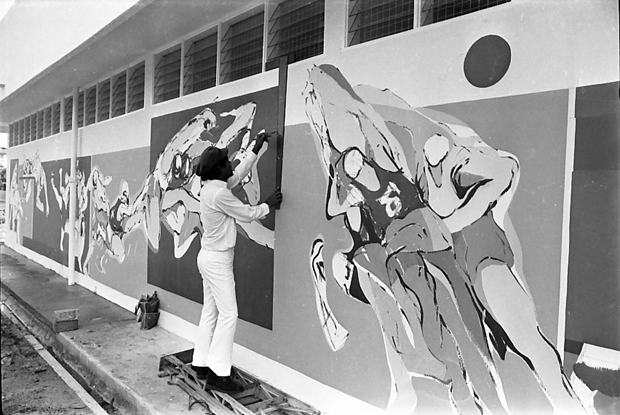
(Datuk) Ibrahim Hussein at work in the 1970s. UM’s first Resident Artist.
Last Update: 04/05/2026